
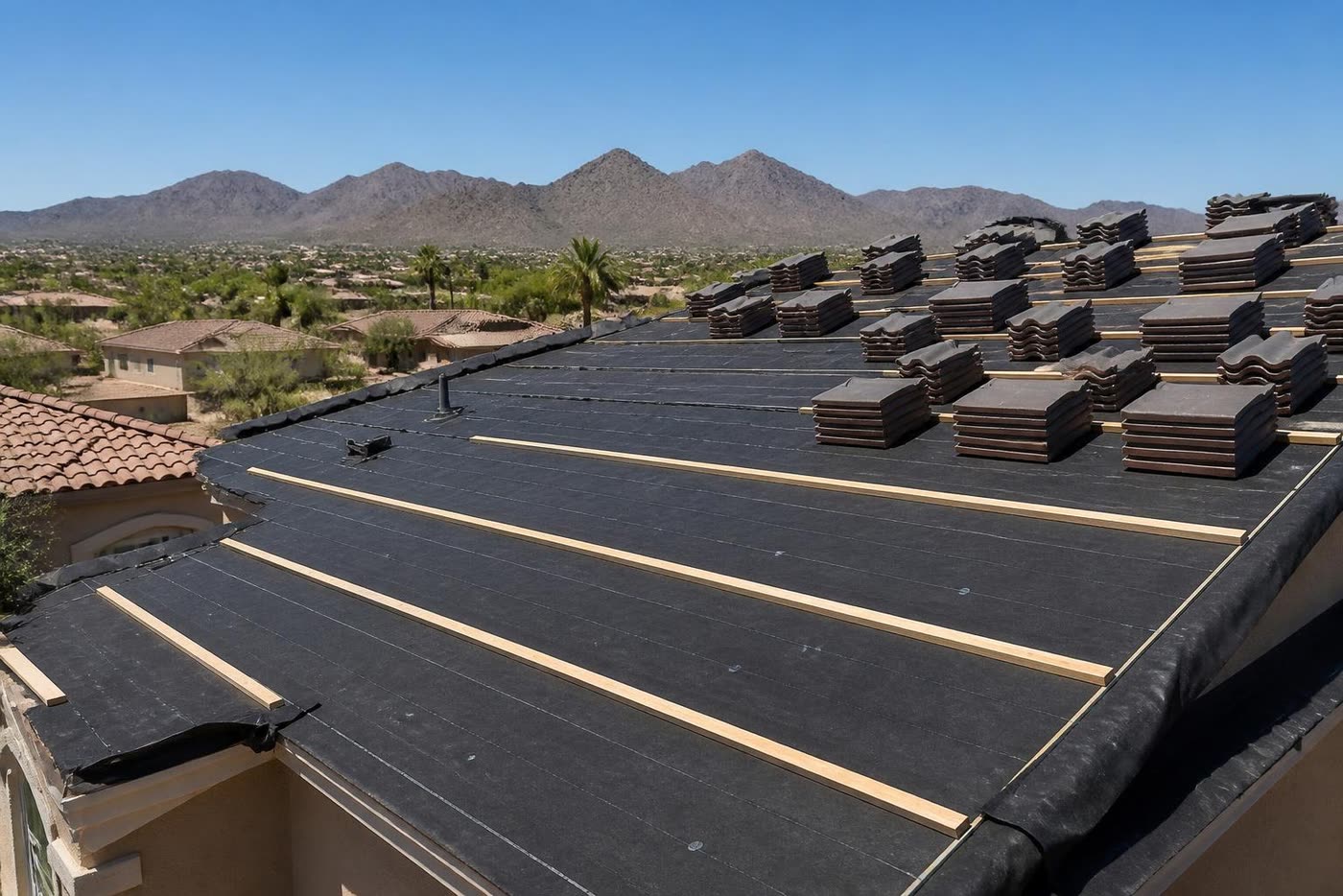
Tile Underlayment Replacement
On most Arizona tile roofs, the tile is not the problem. The underlayment beneath it is — the layer that actually keeps water out, and the one that dries, cracks and fails long before the tile does. We lift and stack your existing tile, replace the underlayment, and set the tile back down.
Tile Underlayment Replacement Services
Your Tile Stays
Sound tile gets reused, which is why this costs a fraction of a full tile roof replacement.
Scoped Honestly
If only two slopes are failing, we quote two slopes — and tell you what the rest has left.
Done To Spec
New underlayment, new flashing and new valley metal installed to the manufacturer's specification, not patched over.
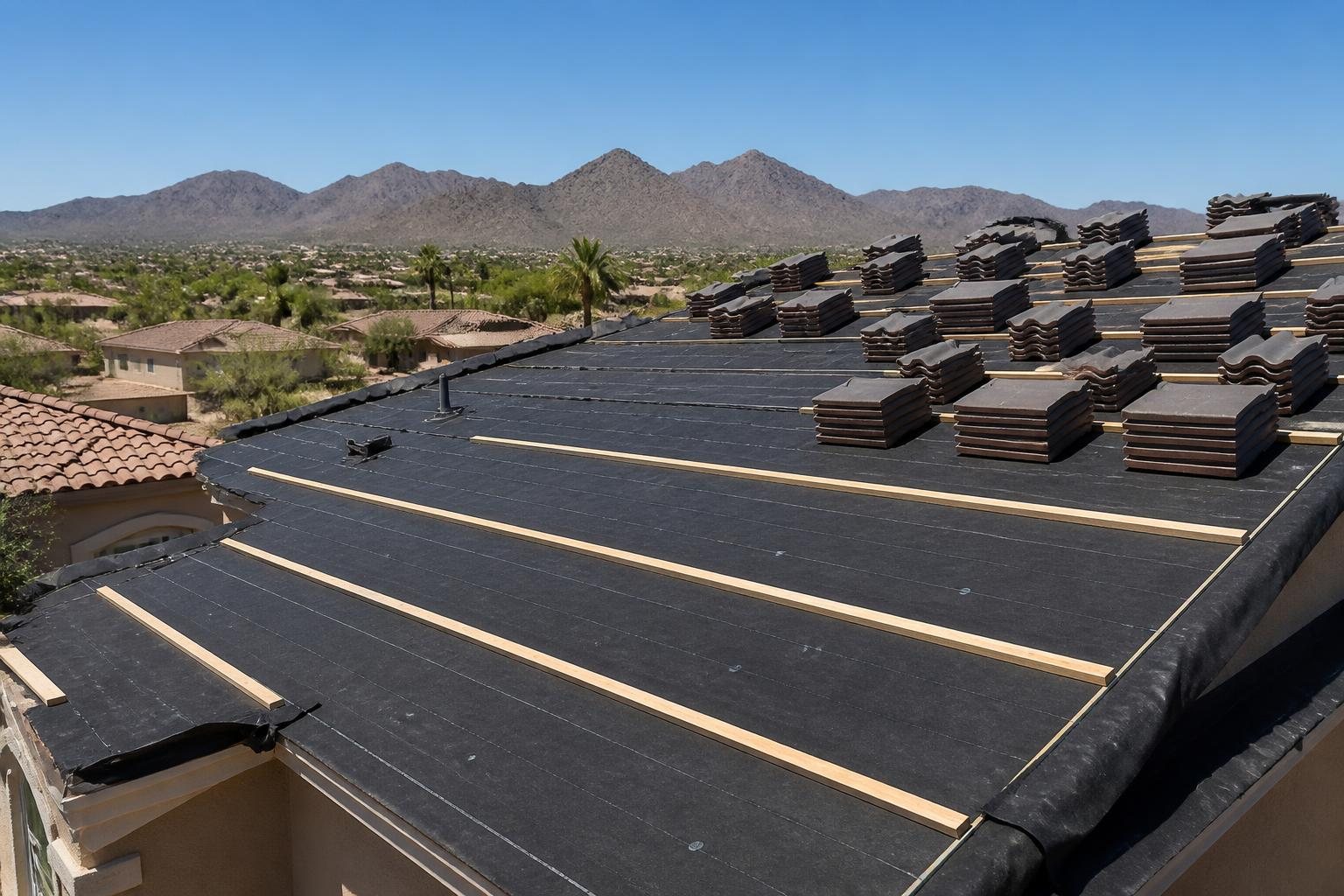
The Desert Ages Underlayment, Not Tile
Tile is a rain screen. It sheds most of the water, takes the sun and the hail, and lasts fifty years or more doing it. The underlayment underneath is the part that actually waterproofs your house, and it is made of asphalt and fiber — material that heat destroys.
Under tile on a July afternoon in the Valley, the deck can run far hotter than the air temperature outside. The asphalt in the felt slowly cooks out of it. Day to night, the roof expands and contracts through a swing that would be unusual anywhere else in the country, and the felt works against its fasteners every cycle. By the time the first monsoon pushes water sideways under the tile, the layer meant to stop it has gone brittle, shrunk back from the laps and split along the nail line.
That is why a tile roof here almost never fails the way people expect. The tile looks fine from the street — because it is fine. The twenty-year-old paper under it is not.
- Ceiling stains after a driving rain, not a steady one: Water gets under tile when wind drives it sideways. A leak that only shows up in a monsoon, and not in a calm all-day rain, points at the underlayment rather than a broken tile.
- Stains that appear away from the obvious spot: Water runs down the felt and along the deck before it finds a way through. The wet patch on your ceiling is often several feet from where it actually got in.
- Granules collecting in the gutters or at downspouts: That is the surface of the felt washing off. On a tile roof it means the layer underneath is wearing through.
- Visible felt at the eave line that is cracked or curled: Where the felt is exposed at the roof edge you can often see its condition without going up. Brittle, curled or shrunken edges indicate the rest.
- A roof in its second decade with original paper: If nobody has replaced the underlayment and the house is around twenty years old, the question is not whether it needs doing but how long you have.
Not All Underlayment Is The Same
Once the tile is off, the material that goes down decides how long before anyone has to do this again. This is the part of the quote worth reading closely, because the labor to lift and reset your tile costs the same whichever one a contractor uses — and that labor is roughly 60% of the job. Paying for the cheapest material saves a little now and buys back the least time.
| Material | Typical life in the Valley | Relative material cost | Best for |
|---|---|---|---|
| 30 lb asphalt feltThe original paper on most Valley homes | Around two decades, less on a hot west-facing slope with poor attic ventilation | Lowest | Matching an existing partial re-felt, or a roof you know you will replace outright before long |
| Synthetic underlaymentWoven polypropylene or polyethylene | Longer than felt, and it does not dry out and shrink the same way | Moderate | Most full tile underlayment replacements — the usual best balance of cost and life |
| Self-adhered (peel-and-stick)Modified bitumen membrane with an adhesive back | Longest of the three, and it seals around every fastener that goes through it | Highest | Low-slope sections, valleys, eaves and anywhere wind-driven water concentrates |
Most roofs do not need one material everywhere. A common and sensible scope is self-adhered in the valleys, at the eaves and on any low-slope section, with synthetic across the open field — which puts the money where water actually collects. Whatever we quote, the product is named by manufacturer and line on the estimate, so you can look it up before you sign.
BINSR Roof Inspections
Underlayment is one of the most common roof items flagged during an Arizona home sale. We inspect, price the work line by line, and can complete it before close of escrow.
What The Job Actually Looks Like
Underlayment replacement is disruptive for a few days and invisible when it's done. Here's the sequence, so nothing about it is a surprise.
- 1Step 1
Inspection & Scope
We get on the roof, pull tile in a few places, and photograph what the felt underneath is actually doing. You get a written scope that says which slopes need work now and which don't.
- 2Step 2
Tile Lift & Stack
Tile comes off by hand and is stacked on the roof or the ground. Some breakage is normal on older tile, so the scope accounts for replacements up front rather than as a surprise line later.
- 3Step 3
New Underlayment
Old felt, fasteners and debris come off down to the deck. Damaged decking gets replaced, then new underlayment goes down with new valley metal, flashing and penetration boots.
- 4Step 4
Tile Reset & Cleanup
Your tile goes back down, broken pieces are swapped for matching replacements, and the site is magnet-swept. You get photos of the work under the tile, because you'll never see it again.
Tile Underlayment Replacement FAQs
What is tile roof underlayment?
It's the waterproof membrane between your tile and the roof deck. Tile sheds most of the water and takes the sun, but the underlayment is what actually keeps the house dry. When people say a tile roof is leaking, the underlayment is usually what failed.
How long does underlayment last in Arizona?
Original felt on Valley homes commonly starts failing somewhere around the two-decade mark. Heat, attic ventilation, roof pitch and the quality of the original install all move that number, which is why an inspection beats a rule of thumb.
Do I need a whole new tile roof if it's leaking?
Usually not. If the tile is in decent shape, replacing the underlayment and resetting the same tile fixes the leak and resets the clock on the roof. We'll tell you plainly when a roof is far enough gone that replacement is the better spend.
How much does tile underlayment replacement cost?
It comes down to square footage, pitch, how much tile breaks, how much decking needs replacing, and whether the whole roof or a couple of slopes need the work. We inspect for free and price it line by line rather than quoting a number over the phone.
What drives roof cost in PhoenixCan you reuse my existing tile?
In most cases, yes — that's the point of the job. Expect some breakage on older or brittle tile. We account for replacements in the scope and source matching tile where we can.
What if my tile profile is discontinued?
We source from tile yards and salvage inventory around the Valley, and it's often possible to find a match. When it isn't, we can pull tile from a less visible slope to keep the street-facing elevation uniform and blend the replacements where they show least.
What if there are solar panels over the area?
The panels have to come off before we can re-felt underneath them. We don't remove or reinstall arrays — your solar installer handles that — but we'll schedule our work around theirs so the roof isn't left open.
Should I do the whole roof or just the slope that's leaking?
It depends on how far apart in age the slopes are. Underlayment on a south and west-facing slope ages faster than the north side, so if the failing slopes are a few years ahead of the rest, doing only those is a legitimate call and we'll scope it that way. But if everything went down at the same time and the rest is close behind, doing it in pieces means paying the tile lift and reset labor twice. We'll tell you which situation you're actually in and what the rest of the roof has left.
How long does it take, and do I need to move out?
A typical Valley tile roof runs a few days of crew time, longer if there's decking to replace or a lot of tile breakage. You can stay in the house the whole time. It is loud — tile coming off and going back on is not quiet work — and the attic may get dusty. We don't leave a roof open overnight; whatever is stripped in a day is dried in before the crew leaves.
Why do contractors' square-foot prices vary so much?
Often because they're not measuring the same thing. A lot of online pricing quotes dollars per square foot of your home's floor area, while the roof is quoted in roof area — which is typically 1.1 to 1.3 times larger on a low-slope home, and more on a steep or cut-up roof. A per-foot figure multiplied by the wrong number can be off by thousands. We measure the roof itself, in squares, and the estimate shows the measurement we used so you can compare quotes on the same basis.
What drives roof cost in PhoenixWill I be able to tell the work was done properly?
Not by looking at it — which is exactly the problem with this job. Once the tile is back down, every dollar you spent is invisible, and that's why underlayment is an easy place to cut corners. We photograph the deck once it's stripped, the new underlayment going down, and the flashing and valley metal before the tile covers them. Those photos go to you with the final invoice.